
When selecting a mattress for your baby’s crib, you should consider all of the factors listed below. Your selection process will help create a safe and comfortable environment for your baby to sleep in. While many parents emphasize the quality of the materials used to construct the mattress, its firmness or softness, and cost; there is another factor that is just as important. That factor is the size of the mattress. If you select a mattress that does not properly fit the size of the crib, it can result in spaces between the mattress and the sides of the crib. These spaces could be hazardous to your child.
The size of a full-size crib mattress is typically the same across most manufacturers in the U.S. There are other types of cribs (mini-cribs, portable-cribs, etc.) that have unique size requirements. Knowing what size you need will allow you to find a mattress that will fit your baby’s crib.
The purpose of this guide is to explain the standard size of a crib mattress, the size of a “mini” crib, how thick a mattress should be, what to look out for when you purchase a mattress and what to take into consideration before making your final decision.
What Are Standard Crib Mattress Dimensions?
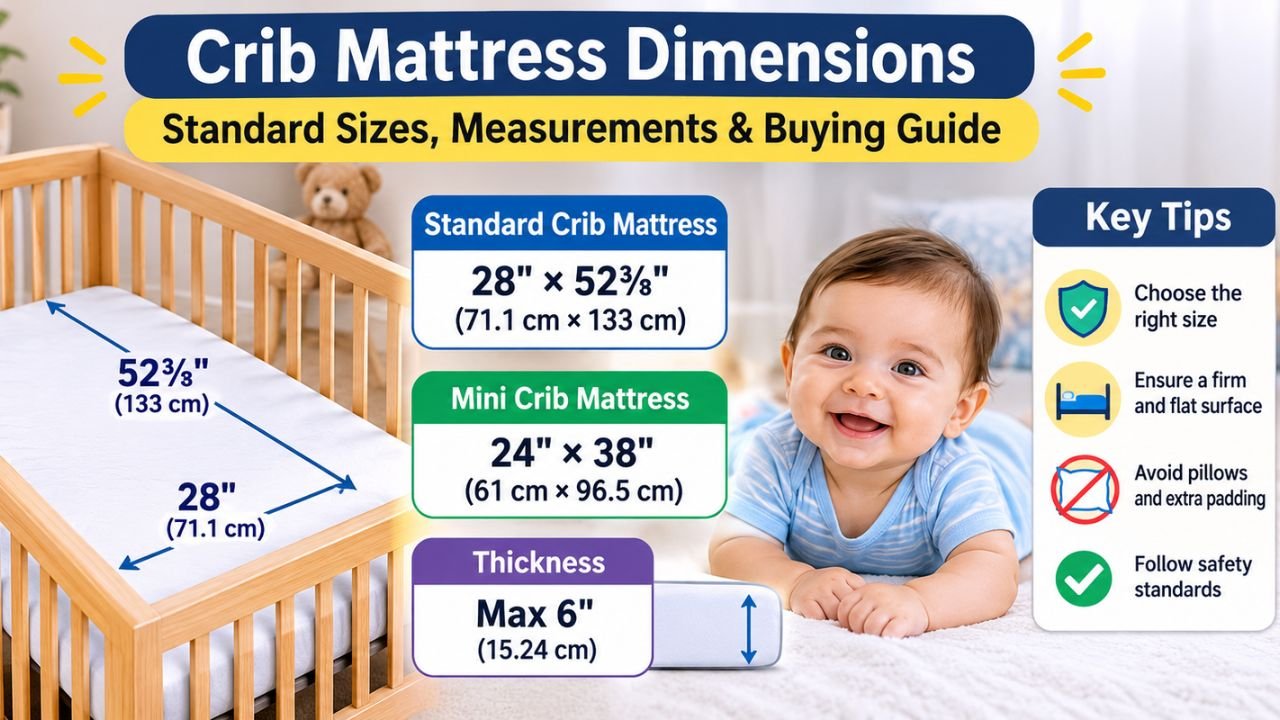
The typical width of a standard size full-sized crib mattress in the U.S. is about 28 inches. The typical length of a standard size full-sized crib mattress in the U.S. is about 52 3/8 inches. These dimensions were set forth by federal regulations regarding crib mattress sizes.
Manufacturers often state that they produce “standard” sized crib mattresses; however, there is usually some variation in size. Parents should make sure to read both the manufacturer’s measurements and the crib’s installation manual prior to purchasing a crib mattress.
The most helpful way to think about this is that the measurements of 28 x 52 3/8 inches are approximate interior measurements for a full size crib. They do not refer to minimum mattress size. When the new U.S. mattress standard goes into effect on May 3, 2026, a full-size crib mattress will need to be at least 27 1/4 inches wide and 51 5/8 inches long.
Standard Crib Mattress Size Chart
The following chart gives commonly encountered crib mattress sizes. Actual dimensions can vary by manufacturer and crib model.
| Mattress type | Approximate width | Approximate length |
| Standard crib mattress | 27¼–28 inches | 51⅝–52⅜ inches |
| Mini crib mattress | 24 inches | 38 inches |
| Portable crib mattress | Model-specific | Model-specific |
| Non-standard crib mattress | Model-specific | Model-specific |
The standard mattress measurements are based on US full-size crib requirements. Mini crib measurements are common market dimensions, not universal requirements. Always follow the crib manufacturer’s compatibility instructions.
1. Standard Full-Size Crib Mattress Dimensions
A standard full-size crib mattress is designed for a full-size baby crib. It is the most commonly available crib mattress category in the United States.
The interior of a full-size crib measures approximately:
- Width: 28 inches (71.1 cm)
- Length: 52⅜ inches (133 cm)
The mattress must measure at least 27¼ inches (69.2 cm) wide and 51⅝ inches (131.1 cm) long under the applicable US standard.
These measurements help ensure that the mattress fits inside the crib without creating an unsafe opening around its edges. Parents should check the crib’s manual and mattress label instead of relying only on product descriptions.
2. Mini Crib Mattress Dimensions
A mini crib is a smaller version of a standard baby crib. It is useful for smaller bedrooms, apartments, shared rooms, and spaces where a full-size crib may be difficult to accommodate.
The most common mini crib mattress size is approximately:
- Width: 24 inches (61 cm)
- Length: 38 inches (96.5 cm)
Mini crib mattresses are generally shorter and narrower than standard crib mattresses. Their thickness can also vary depending on the manufacturer.
Not every mini crib uses the same dimensions. Some models have unique shapes or measurements, so parents should purchase a mattress specifically approved for their crib model.
3. Portable Crib Mattress Dimensions
Portable cribs offer a portable sleeping area that can be moved or packed away after use. These portable cribs are commonly used during trips, at grandparents’ houses, and as temporary sleep solutions.
Portable cribs differ from standard full-size cribs in that they use many different mattress size configurations. The mattress size used with a portable crib depends on its design.
Some types of portable cribs utilize smaller size rectangular mattresses, but many types of portable cribs utilize custom-made, folded, or built-in sleep surfaces.
Before you purchase a replacement mattress, you should find out what the exact model number of your current mattress is and then read the manufacturers’ instructions. Even though a mattress looks very much like another one in terms of size, it could be totally incompatible with your crib.
4. Crib Mattress Thickness
The next consideration after determining how much space you have in your baby’s nursery, is the thickness of the crib mattress. When choosing a crib mattress, it needs to fill the space in your baby’s crib correctly and be high enough so that it doesn’t fall below the required level of the sides of the crib.
Under the current U.S. crib standards, a full-size crib’s mattress cannot be more than 6 inches thick. Also, the mattress must be firm, flat, and intended for use with infants.
The thickness of a mattress does not determine whether it will be comfortable or safe for your child. It is important to know that there are different mattress thicknesses available based upon the design of the crib you have chosen, as well as the manufacturer’s recommendations.
Parents ought to refrain from adding any kind of topper (mattress), pillow, blanket, or other types of padding to alter the height of their child’s bed (or mattress) or make it softer.
5. Crib Mattress Dimensions in Inches and Centimeters
For parents who prefer metric measurements, the following conversion chart makes it easier to compare crib mattress sizes.
| Measurement | Inches | Centimeters |
| Standard crib interior width | 28 | 71.12 |
| Standard crib interior length | 52.375 | 133.03 |
| Minimum mattress width | 27.25 | 69.22 |
| Minimum mattress length | 51.625 | 131.13 |
| Common mini crib width | 24 | 60.96 |
| Common mini crib length | 38 | 96.52 |
| Maximum full-size crib mattress thickness | 6 | 15.24 |
These conversions are rounded for easy reference. Always use the exact measurements and compatibility information provided by the manufacturer.
6. How to Measure a Crib Mattress Correctly
Buying a new crib mattress may cause you to have fitting issues if you don’t take measurements of your current crib mattress. Using a measuring tape to find out what size mattress you currently own will help you buy the right size.
Measure the width: Stretch the measuring tape over the shortest side of the mattress. Take the measurement of that distance from the outer edge to the other outer edge.
Measure the height: Measure from the top edge to the bottom edge on the longest side.
Measure the thickness: Lay the mattress down on a flat area and then vertical measure from the base of the mattress to the top edge of the mattress where you would sleep.
Measure the inside of the crib: Measure both the inside width and length of your crib’s frame. Make sure you don’t use the measurements on the outside of your crib as the mattress will need to be placed inside.
Be sure to check your measurements against the manufacturer of your crib’s specifications prior to purchasing a replacement.
7. Why Is the Correct Crib Mattress Size Important?
Selecting the correct mattress size is not simply about making the crib look neat. It is an important part of creating a safe sleeping environment.
Here are the main reasons why proper mattress dimensions matter.
Prevents Dangerous Gaps
A mattress that is too small can leave gaps between the mattress and crib sides. These spaces may create an entrapment or suffocation hazard for babies.
Provides a Stable Sleeping Surface
A properly fitted mattress stays in its intended position and provides a stable surface for sleeping.
Maintains Crib Safety
Cribs are designed to work with mattresses that meet specific size and compatibility requirements. Using an unsuitable mattress can affect the safety of the entire sleeping setup.
Avoids Unnecessary Replacement Costs
Checking the mattress dimensions before purchasing helps parents avoid buying an incompatible product and spending additional money on replacements.
8. How to Choose the Right Crib Mattress
Finding a crib mattress involves more than comparing prices and dimensions. Parents should consider several factors before making a purchase.
Check the Crib Model
Start by identifying the crib’s brand and model number. Read the product manual to find the recommended mattress measurements.
Choose a Firm Mattress
Babies need a firm, flat sleeping surface. A soft mattress may allow the baby’s face to sink into the surface, increasing the risk of suffocation.
Check Mattress Compatibility
Make sure the mattress is specifically intended for your crib. Do not assume that two mattresses with similar dimensions will fit equally well.
Consider Mattress Materials
Crib mattresses are available in different materials, including foam and innerspring designs. Compare the construction, durability, cleaning instructions, and product safety information.
Check Product Certifications and Standards
Look for products that comply with applicable safety requirements in the country where they are sold. In the United States, crib mattresses are regulated under CPSC requirements, including 16 CFR Part 1241.
9. Common Crib Mattress Buying Mistakes
Parents sometimes make simple mistakes when choosing a mattress. Avoiding these problems can make the purchasing process easier.
- Buying based only on the product name: A mattress advertised as standard size may not be compatible with every crib.
- Ignoring the manufacturer’s instructions: Always check the recommended mattress dimensions.
- Choosing a mattress that is too small: An undersized mattress may leave dangerous gaps.
- Adding extra padding: Mattress toppers and supplemental padding should not be added to an infant’s sleep surface.
- Confusing portable cribs with mini cribs: These products may have different mattress requirements.
- Ignoring mattress firmness: A baby mattress should be firm and flat rather than soft or excessively cushioned.
10. Standard Crib Mattress vs Mini Crib Mattress
Standard and mini crib mattresses are designed for different crib sizes. Understanding their differences can help parents select the right option.
| Feature | Standard Crib Mattress | Mini Crib Mattress |
| Typical width | Around 28 inches | Around 24 inches |
| Typical length | Around 52 inches | Around 38 inches |
| Sleeping space | Larger | Smaller |
| Crib type | Full-size crib | Mini crib |
| Room requirement | More space | Less space |
| Mattress availability | Widely available | Depends on model |
| Compatibility | Full-size cribs | Specific mini cribs |
A standard crib mattress is suitable for a compatible full-size crib, while a mini crib mattress is intended for a smaller crib. Neither should be substituted for the other.
11. How Often Should You Replace a Crib Mattress?
There is no single replacement schedule that applies to every crib mattress. The condition of the mattress and the manufacturer’s recommendations are more important than its age alone.
Consider replacing a crib mattress when:
- It has visible damage, tears, or exposed internal materials.
- The surface has become uneven or excessively worn.
- It no longer fits the crib correctly.
- It has been exposed to moisture, mold, or significant contamination.
- The manufacturer recommends replacement.
A mattress should always maintain its original shape and firmness. If you notice sagging, damaged seams, or changes in the sleeping surface, stop using it until its safety has been evaluated.
12. Crib Mattress Safety Tips for Parents
A correctly sized mattress is only one part of safe infant sleep. Parents should also follow basic sleeping guidelines.
- Place babies on their backs for every sleep.
- Use a firm, flat, non-inclined mattress.
- Use a fitted sheet designed for the specific mattress.
- Keep pillows, stuffed toys, loose blankets, and other soft objects out of the crib.
- Never use an extra mattress or mattress topper to fill a space.
- Follow the crib and mattress manufacturer’s instructions.
- Check the mattress and crib regularly for damage.
These precautions help create a safer sleeping environment for infants.
Conclusion
By knowing what size crib mattress you need, you will be able to choose a mattress that fits perfectly into your child’s crib. Full size crib mattresses have inside dimensions of about 28 x 52 3/8 inches and a mini crib mattress is usually around 24 x 38 inches.
In addition to dimensions, there are many other factors to consider when making a purchasing decision. Before buying a crib, make sure to read the manufacturer’s guidelines, ensure the mattress is compatible with the crib, and select a sleeping area which has been found to be safe for infants.
By taking these steps parents will have created a more secure and comfortable place for their child to sleep.
Read Also: Pickleball Dimensions || Cornhole Board Dimensions || King Size Blanket Dimensions
Frequently Asked Questions
1. What are the standard crib mattress dimensions?
A standard full-size crib mattress measures at least 27¼ inches wide and 51⅝ inches long under the applicable US safety standard. The interior dimensions of a full-size crib are approximately 28 inches wide and 52⅜ inches long.
2. Are all standard crib mattresses the same size?
Standard full-size crib mattresses follow defined size requirements, but small measurement differences can occur between products. Always check the manufacturer’s specifications and confirm compatibility with your crib.
3. What size is a mini crib mattress?
A common mini crib mattress measures approximately 24 inches wide and 38 inches long. However, mini crib dimensions are not universal, so you should check the specific crib model before purchasing.
4. How thick should a crib mattress be?
A full-size crib mattress must not exceed 6 inches in thickness under applicable US crib requirements. The exact recommended thickness should also follow the crib manufacturer’s instructions.
5. Can I use a standard crib mattress in a mini crib?
No. A standard crib mattress is generally too large for a mini crib. Always purchase a mattress specifically designed and approved for the mini crib model.