
Cornhole is a common backyard party game, often associated with family barbecues, tailgate parties and outdoor fairs. The size of the board determines how far apart you place them, so whether you’re building a DIY board or are looking to buy a product set up for you, learning about the proper cornhole board dimensions helps ensure you have everything lined up correctly for your games.
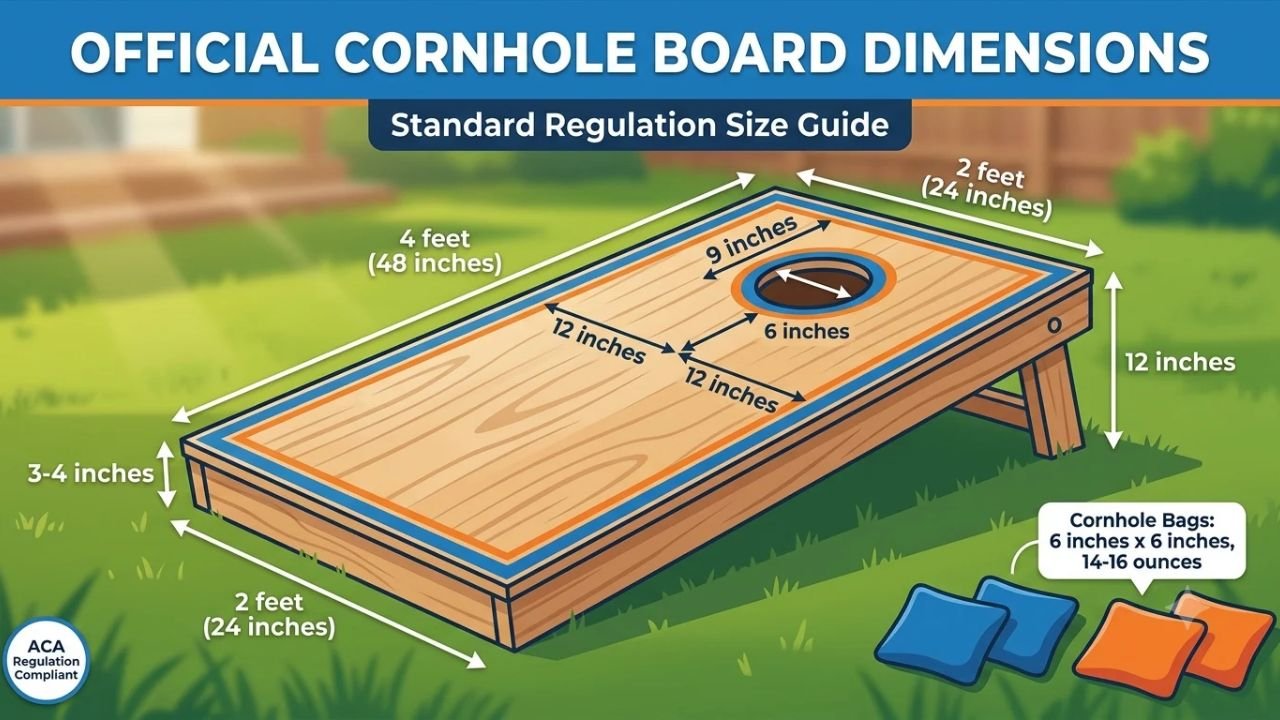
The average cornhole board measures 48 inches in length, 24 inches wide, and has a 6-inch diameter hole toward the top. The board’s back edge is raised and its front edge lowered to create a sloping playing surface. This guide covers standard board size, hole locations and elevation, throwing distance and bean bag specs.
Standard Cornhole Board Dimensions
The standard cornhole board size is designed to provide a consistent playing experience for recreational and competitive players. The rectangular playing surface offers enough room for players to aim their bags at the hole or land them on the board.
Here are the main measurements to consider when building or purchasing a cornhole board.
| Board Feature | Standard Measurement |
| Board length | 48 inches (4 feet) |
| Board width | 24 inches (2 feet) |
| Length in centimeters | 121.92 cm |
| Width in centimeters | 60.96 cm |
| Hole diameter | 6 inches (15.24 cm) |
| Hole center from top edge | 9 inches (22.86 cm) |
| Hole center from either side | 12 inches (30.48 cm) |
| Front height | 3–4 inches (7.62–10.16 cm) |
| Rear height | 12 inches (30.48 cm) |
| Distance between boards | 27 feet (8.23 meters) |
| Bean bag size | Approximately 6 × 6 inches |
| Bean bag weight | 15–16 ounces |
These measurements provide a useful reference when planning a cornhole game area or constructing a standard-size board.
Cornhole Board Length and Width
A full-size cornhole board is 48 inches long by 24 inches wide. That with a unit spacing of 4×2 in ft, or equal to roughly 4 years. The playing area must be rectangular and the surface must be smooth, level and strong enough to withstand multiple throws of bags.
Plywood is a popular choice for cornhole boards because it provides a good playing surface while also allowing the board to be bolted onto a wooden frame. For DIY, both ½ inch and ¾ inch plywood can be used but the strength and stability of the board is directly connected with the entire assembly.
Choose your board with utmost care; its dimensions are clear. A compact or travel board can be imported for kids, but most full-size boards are best if you plan on playing casually and aren’t used to a normal chess set.
Cornhole Hole Size and Placement
Cornhole has a hole right at its center, and its diameter and position are significant as this is the primary target of cornhole. A regulation hole is 6 inches in diameter, or wide enough to make it through if the bag was thrown correctly.
The hole is centered on the board left to right. Because the board is twenty-four inches wide, center of hole is 12 inches away from either side. Its center is at 9 inches from the top edge of the board.
For attacking the hole, you will measure nine inches down from one top edge and twelve inches across from each side. Identify the middle point and create a 3 inch radius circle. Cut out the opening with a suitable tool and sand down the edges to remove any splinters.
The hole placement is done correctly which allows the board to stay of regular dimension and at the same time gives players an even ground during the game.
Cornhole Board Height and Playing Angle
First, the height of a cornhole board affects bag movement over its surface. On a normal board, the front edge is somewhere around 3–4 inches off the ground and the rear edge 12 inches high.
This difference creates a sloped playing field. Bags can slide after they have landed toward the hole depending on the data surface finish, throw force and bag position.
The specific playing angle is dictated by the front height and distance between front & rear supports. This is why the legs should be deployed and locked before play on a flat surface.
If you’re making your own board, measure the front height and rear height once you put the legs on. Prevents throwing movement due to having a stable frame.
Distance Between Cornhole Boards
As you know there is a regulation 27 feet distance between to premium cornhole boards when set up for play, measured from the front edge of one board to the front edge of the second board.
The boards must be set face to face and in a straight line. Measuring from the front edges ensures proper playing distance without concern for how long (or short) the boards are overall.
When it comes to kids, new players, and friendly backyard games you can bring the boards closer together to make throwing easy. However, there are others that may benefit from practicing at the full distance for tournaments (use a competition rulebook to check which events apply).
Well cut space between them so players can throw safely and walk without any obstructions up to 10s away from the boards.
Cornhole Bean Bag Size and Weight
Cornhole bean bags are usually square and have dimensions of about 6 inches x 6 inches. Standard Competition bags are about 15 to 16 ounces.
Can hold and throw with gusto. Their weight helps gives them a consistent feel, but on landing on the board, it is the fabric and filling that determines whether they slide or stop dead.
When buying a cornhole set, look for bags of uniform size and weight! Having both teams throw into similar bags helps develop practice consistency and focus on throwing accuracy.
Best Material for a Cornhole Board
If you want to build a board that can withstand daily use, choosing the right materials is key. Smooth plywood is a popular option, as it gives a solid base and which can be mounted on a strong timber framework.
A sheet of 1/2-inch plywood is acceptable if it has a solid foundation from the frame (raft) below. A 3/4-inch sheet, for example, gives a thicker playing surface but is heavier and harder to carry.
The playing surface must be free of rough areas like loose splinters, raised screw heads, and bumps. A good paint or finish will last longer, but be sure to apply it evenly so that your bags move uniformly!
Use moisture resistant materials if the board will be exposed to rain for a lengthy period of time and keep it covered when not in use. Stored right can help it not only be used for a long time.
How to Build a Standard Cornhole Board
Building your own cornhole board allows you to customize its appearance while following standard measurements. Before starting, gather plywood, lumber, screws, a measuring tape, a pencil, suitable cutting tools, and sandpaper.
Step 1: Cut the Playing Surface
Prepare a rectangular plywood panel measuring 48 inches long and 24 inches wide. Check the edges and make sure the panel is flat before attaching it to the frame.
Step 2: Mark the Hole
Measure 9 inches from the top edge and 12 inches from either side. Mark the center and draw a circle with a 6-inch diameter.
Step 3: Cut the Opening
Cut along the marked circle using an appropriate tool. Smooth the inside edge with sandpaper to remove rough areas and splinters.
Step 4: Assemble the Frame
Build a rectangular frame beneath the playing surface and secure the plywood using suitable fasteners. The frame should support the board firmly without excessive flexing.
Step 5: Attach the Legs
Install stable legs that position the rear edge 12 inches above the ground and the front edge approximately 3–4 inches above the ground. Check the board on a level surface.
Step 6: Finish and Test the Board
Sand the playing surface, apply an appropriate finish, and allow it to dry completely. Place the board on level ground and check its stability before throwing bags.
Regulation Cornhole Board vs. Mini Cornhole Board
Now there are full-size cornhole boards and mini cornhole boards. An official Regulation sized board is designed for use with adult playing pieces and should be used in practice as it is indeed regulation size. Mini boards – Smaller, lighter, more portable for travel/play room/kids.
Different hole sizes, board heights and playing distances may be found in mini boards. Just because they look like a full-size board doesn’t automatically gin up regulation equipment status for them.
If you intend to play in organized competitions select a board that conforms to the newest specifications as dictated by the relevant governing body.
Conclusion
Understanding the appropriate cornhole board sizes allows for simpler construction of a board, purchasing of proper gear and preparing a suitable playing environment. Standard board: 48 x 24 in for a 6-inch hole running north-south (to the ground), with a height of 12 inches at the back. The front edge is about 3–4 inches tall and the standard adult playing distance is 27 feet, from front edge to front edge.
Whether you build your own board or buy a whole set, proper measurements, a level frame and smooth play surface all contribute towards an even playing game. Verify the current specifications with the accredited constellation governing body before committing to competition kit.
Read More: Shake Weight Loss || Taylor Swift Weight || Shaq Weight
Frequently Asked Questions
1. What are the standard cornhole board dimensions?
A standard cornhole board measures 48 inches long and 24 inches wide, equivalent to 4 feet by 2 feet.
2. How big is the hole on a cornhole board?
The standard hole is 6 inches in diameter, with its center positioned 9 inches from the top edge and centered across the board’s width.
3. How far apart should cornhole boards be?
For standard adult play, the front edges of the two boards should be 27 feet apart.
4. How high is a standard cornhole board?
The front edge is approximately 3–4 inches above the ground, while the rear edge is 12 inches high.
5. What is the standard cornhole board size in centimeters?
The standard playing surface measures approximately 121.92 cm long and 60.96 cm wide.
1 thought on “Cornhole Board Dimensions: Standard Size, Height, Hole Placement, and Distance”