
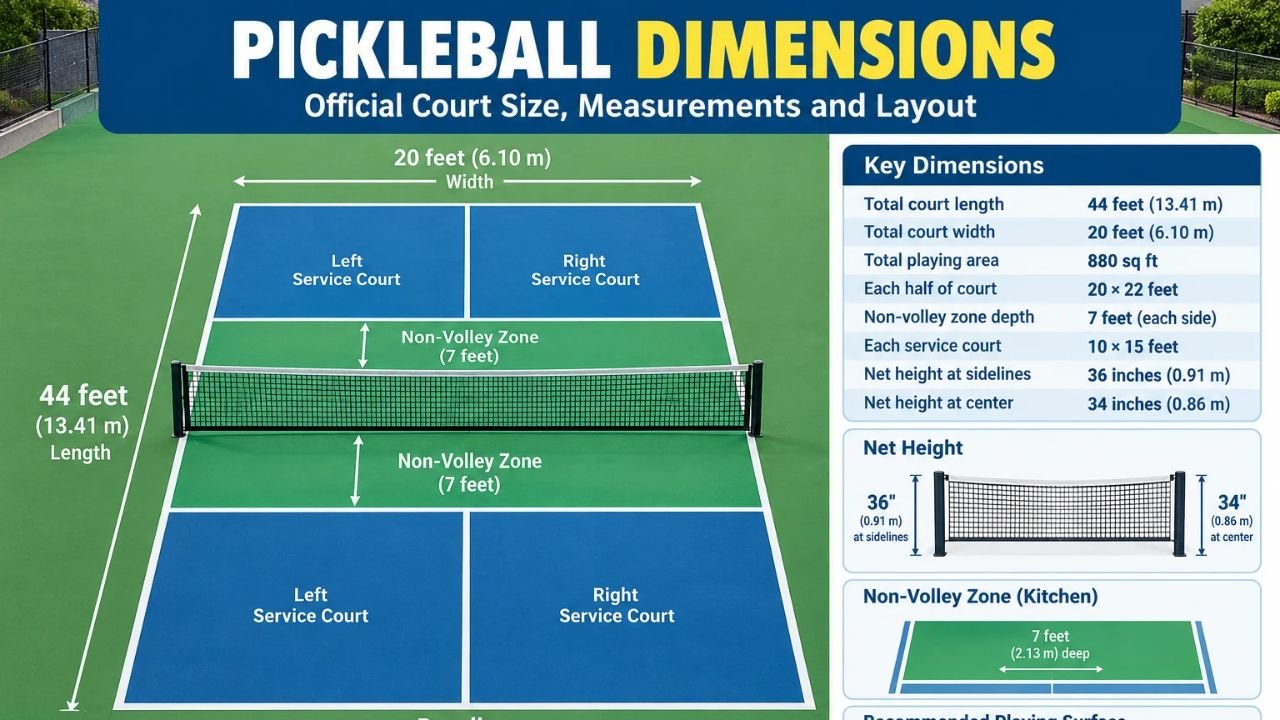
Pickleball is a paddle sport that incorporates various elements of tennis, badminton and table tennis. The game can be played by people across all ages and skill levels, making it an excellent choice for a recreational activity, fitness or competitive tournaments. When preparing to play pickleball or design your court, proper pickleball size are important.
The dimensions of a standard pickleball court are 20 feet wide and 44 feet long. The dimensions remain the same whether singles or doubles. But the court rules do provide exact measurements for the net, service areas, non-volley zone and boundary lines.
In this guide, official pickleball court measurements (by feet and meters), playing area size, net height, and pickleball court construction space.
What Are the Official Pickleball Dimensions?
Information about a regulation pickleball court, according to 2026 USA Pickleball Official Rulebook, says no more than widths of over 20 feet or lengths greater than 44. These measurements are for both singles and doubles matches.
A net spanning the full width of the court divides it into two equal halves. Both halves measure 20 feet wide and 22 feet. Both sides include a non-volley zone in front of the net and two service courts behind that zone.
Here are the standard pickleball court measurements:
| Court Feature | Official Dimensions |
| Total court length | 44 feet (13.41 meters) |
| Total court width | 20 feet (6.10 meters) |
| Total playing area | 880 square feet |
| Each half of the court | 20 × 22 feet |
| Non-volley zone depth | 7 feet on each side |
| Each service court | 10 × 15 feet |
| Net height at sidelines | 36 inches |
| Net height at center | 34 inches |
| Recommended new-court playing surface | 34 × 64 feet |
These measurements provide the foundation for designing a regulation court. Players should also consider the additional space needed around the playing area for movement and safety.
Pickleball Court Dimensions in Feet
The plastic surface that covers the area from breakpoint to breakpoint is 44 feet in length from both baselines. It has a total area of 880 square feet, which is the result of length times width.
The length of a court divides evenly in half through the center of the net. Each wing stretches 22 feet from the net to the baseline.
All of the above dimensions are done across the entire width of 20 feet wide on each end of the court. Boundary lines define the playing area and there is a centerline that divides the service courts on either side.
When conpared to a tennis court, these measurements are rather small, allowing pickleball courts to be compact. One the reasons you can play pickleball in community sports facilities, recreation centers, school gyms or even dedicated outdoor courts.
Pickleball Court Dimensions in Meters
For people who prefer the metric system, the official court dimensions can be converted into meters and centimeters.
A standard pickleball court measures approximately 6.10 meters wide and 13.41 meters long. Its total playing area is approximately 81.75 square meters.
The following measurements provide a useful reference when planning or marking a court.
| Court Feature | Measurement in Meters |
| Court length | 13.41 m |
| Court width | 6.10 m |
| Each half | 6.10 × 6.71 m |
| Non-volley zone depth | 2.13 m |
| Service court width | 3.05 m |
| Service court depth | 4.57 m |
| Net height at sidelines | 0.914 m |
| Net height at center | 0.864 m |
When constructing a court, use the official measurements and make sure the lines are positioned accurately. Small errors in the placement of the non-volley zone or boundary lines can affect gameplay.
Pickleball Court Layout and Markings
First, there are several lines and playing areas in a pickleball court. Every single marking you see has its own purpose, and learning the nuances of these areas is crucial to play the game by-the-book.
Baselines
Two ends of the court, where the baselines are. The 20-foot (6.1 m) baseline runs from sideline to sideline behind each net.
When serving, players stand behind the baseline. It is also the back boundary of the playing area.
Sidelines
The side lines run the length of the court. The two sidelines are 44 feet long and signify the left and right boundaries.
A ball that touches a sideline during a normal rally is in, however players must take note of these lines when returning shots near the edges.
Centerline
The centerline separates the service area on either side into halves. It the part that runs from the non-volley zone line to the baseline.
The width of the service court is 10 feet. The centerline indicates the correct service position, and which box the ball must land in—the one diagonally opposite.
Non-Volley Zone Line
Each side of the net has a non-volley zone line which is put 7 feet from the net. It extends the entire 20-foot width of the court.
This line serves as the back edge of the kitchen (or more generally, non-volley zone). There are special rules forplayers who make a stroke on the ball from this area.
Boundary Lines
The perimeter lines represent the official playing area. The outer edges are formed by the baseline and sidelines, while the kitchen is defined by non-volley zone lines.
Measurements for courts are made all the way to the outside edges of our perimeter (aka baseline, sideline) lines and our non-volley zone lines, in accordance with USA Pickleball specifications. The lines must be distinct and contrast with the playing surface.
What Is the Pickleball Kitchen Dimension?
The kitchen, or in pickleball terms the non-volley zone is by far one of the most important areas in a pickleball court.
Dimensions form a rectangular shape allowing for 7 feet of depth and 20 feet of width on both sides of the net. Thus, creating a 140 square-foot rectangle shape on either side.
The distance from the net to each baseline is exactly 7 feet – that piece is your kitchen. Due to a kitchen on each end, when both sides of the court are taken as a whole, the kitchen area is otherwise 14 feet long.
The line which specify the kitchen is inside of the non-volley zone. When a player is in this area or touches the kitchen line they cannot volley the ball. Hitting the ball without letting it bounce before is the volley.
That said, players can go in the kitchen to smash a ball that has bounced. They need to exit the kitchen and find their balance before volleying again.
Kitchen : in other words, controlled shots, fast footwork and play close to the net. It further differentiates the game of pickleball from other racket and paddle sports.
Pickleball Service Court Dimensions
A pickleball court includes two service courts on each side. This zones are situated between the kitchen line and the baseline.
A service court is about 10-feet wide, by 15-feet deep. There is a centerline that divides the 20-foot width of the court into two 10-foot sections.
The area between the non-volley zone line (which marks how far back a player must stand to serve) and the baseline is known as the service zone. As a result, there is one left service court and one right service court for each side.
The server strikes the ball on a 45-degree angle to the opponent’s opposing service court during a regular perfect example of serve. Serve must clear the non-volley zone and its line. If a serve lands on the kitchen line, it is considered a fault.
Those lines are not just for show, as the placement of service lines determines whether or not a serve is in the correct area.
Pickleball Net Dimensions and Height
The net separates the two halves of a pickleball court. Its height is slightly lower at the center than at the sidelines.
According to the official 2026 USA Pickleball Rulebook, the required measurements are:
| Net Feature | Official Measurement |
| Height at sidelines | 36 inches (91.44 cm) |
| Height at center | 34 inches (86.36 cm) |
| Distance between posts | Approximately 22 feet |
| Minimum net length between posts | 21 feet 9 inches |
| Minimum net height from bottom to top | 30 inches |
The net posts should be positioned approximately 22 feet apart, measured from the inside of one post to the inside of the other. The net must be installed securely and adjusted to the required height.
The lower center height allows the net to dip slightly in the middle. Players should check the net measurements before competitive matches to ensure that the setup meets the official requirements.
How Much Space Is Needed for a Pickleball Court?
The marked court is only part of the space needed for safe play. Players also require room outside the boundary lines to move, reach wide shots, and avoid collisions.
USA Pickleball specifies a minimum playing surface of 30 feet wide by 60 feet long. For new construction and tournament play, a playing surface of 34 feet wide by 64 feet long is recommended.
| Court Setup | Width | Length | Total Area |
| Marked playing court | 20 ft | 44 ft | 880 sq ft |
| Minimum playing surface | 30 ft | 60 ft | 1,800 sq ft |
| Recommended new-court surface | 34 ft | 64 ft | 2,176 sq ft |
The additional space around the court provides room for players to move safely beyond the marked boundaries.
If you are planning a court in a backyard or private property, measure the entire available area before construction. Consider the surface material, drainage, lighting, fencing, and clearance around the court.
Pickleball Court Dimensions for Singles and Doubles
Today I answer one of the most common questions, do singles and doubles pickleball use different court sizes?
The answer is no. Each of the formats uses a court that is 20 feet wide and 44 feet long.
Singles is where a player plays against another player. This means that each individual must take care of their own side of the court by themselves.
Doubles – two players on each side. Same court width and length, just teammates can share playing responsibilities.
While the dimensions are still essentially the same, doubles games often morph into more cooperative and positioning play close to the kitchen line. This is because, in singles games, each player covers the full width of their side of the court making movement from one side to another more vigorous.
Pickleball Court Dimensions Compared With Tennis
While pickleball is similar to tennis, the courts are different sizes.
An official size pickleball court is rectangular and 20 × 44 feet. Tennis courts are typically 36 × 78 feet for doubles and 27 × 78 feet for singles.
Therefore, paddle court area is much less than tennis courts. Depending on the area, layout and safety clearances required in a specific location, more than one pickleball court can be fitted into an existing tennis facility.
Organising a conversion of a tennis court is not something that can be done willy-nilly. Next the separation between adjacent courts, the areas on court where a player moves as well as new positions of net and lines (court lines).
The smaller court size makes it accessible in places that it may not be practical to build full-size tennis courts.
What Surface Is Best for a Pickleball Court?
The surface on which you play affects the bounce of your ball, how well it grips, comfort and ultimately durability. People also ask, What is the best material for a Pickleball Court?:The best material will depend on if the court is indoors or outdoors and how often it will be used.
Concrete
Concrete offers a solid, hard surface for outdoor pickleball courts. It is commonly seen under an acrylic sports surface, and needs proper finishing to be able to create a low maintenance focused flooring in sports venues.
Asphalt
Another popular outdoor court base is asphalt. You can give it some sort of sports surfacing system that it has traction, and then you have fluidity on the playing time.
Acrylic Sports Surface
Outdoor pickleball courts often have acrylic coatings. They also add color and texture while giving a paddle sports playing surface.
Indoor Sports Flooring
Pickleball can be played on specialized gymnasium flooring as an indoor sport. When deciding on a temporary or permanent court, ensure that the surface provides sufficient grip and a steady bounce.
The surface should be even and safe, regardless of the material, as well as designed to handle drainage waters if specified.
How to Mark a Pickleball Court Correctly
Marking a pickleball court requires accurate measurements and a clear understanding of the layout.
First, identify a flat rectangular area with enough room for both the court and its surrounding playing surface. Measure a rectangle that is 20 feet wide and 44 feet long.
Next, mark the baseline at each end and draw the two 44-foot sidelines. Position the net across the middle, 22 feet from each baseline.
Measure 7 feet from the net toward each baseline to mark the two non-volley zone lines. Then draw the centerline on each side from the kitchen line to the baseline, dividing the service areas into equal sections.
Court lines should generally be 2 inches wide, clearly visible, and consistent in color. Use a reliable measuring tape and suitable marking equipment to reduce measurement errors.
Before using the court for official play, verify all dimensions against the current rulebook and check that the net height is correct.
Conclusion
Knowing how big is a pickleball court helps players as well as homeowners and sports facility managers with laying down the lines of an official playing area. In the standard-size regulation court size, it is 20 feet (6.1 m) in width (the second green line in the above image) and 44 ft (13.4 m) [12]in length. The non-volley zone on each side of the net is 7 ft in length [2].
The net is 36 inches at the sidelines and 34 inches in the center. The trace court is 880 square feet, but players need a wider playing area to move safely.
If you are marking a temporary court, laying out an existing sports area or building a permanent facility, with the right measurements you’ll be able to guarantee a precise and enjoyable playing experience.
Read Also: Cornhole Board Dimensions || King Size Blanket Dimensions || Tennis Court Dimensions || 65 Inch TV Dimensions
Frequently Asked Questions
1. What are the standard pickleball court dimensions?
A standard pickleball court is 20 feet wide and 44 feet long. These dimensions apply to both singles and doubles matches.
2. How many square feet is a pickleball court?
The marked playing court covers 880 square feet. This is calculated by multiplying 20 feet by 44 feet.
3. What are pickleball court dimensions in meters?
A standard court measures approximately 6.10 meters wide and 13.41 meters long, with a total playing area of about 81.75 square meters.
4. How wide is a pickleball court?
The official court width is 20 feet, or approximately 6.10 meters.
5. How long is a pickleball court?
The official court length is 44 feet, or approximately 13.41 meters.