
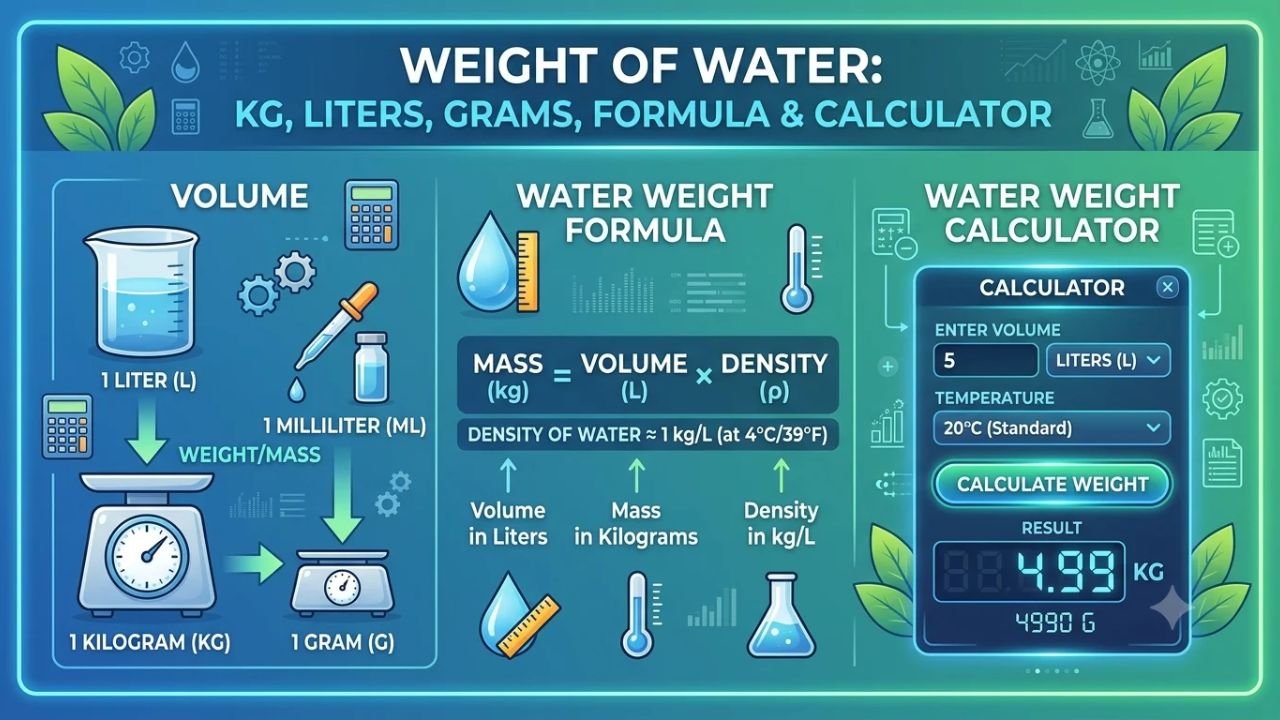
Weight of Water Calculator
Enter the amount of water and select a unit to calculate its approximate weight in milliliters, liters, cubic meters, cubic feet, grams, kilograms, and pounds.
Water weight and fluid balance is a vital literacy used in cooked food, science, engineering (e.g. civil meetings), construction and transportation industry as well as personal activities of daily living. Water is commonly used as a baseline since its density is approximately 1 gram per milliliter (g/mL) at temperatures close to room temperature. This makes a lot of the water conversions relatively straightforward.
As an example 1 mL of water weighs about 1 gram and so 1 Litre of this same fluid weighs approximately 1 kilogram. But the method for sharp mass of drinking water various a little temperature given that density of drinking water is dependent on its temperature.
This guide will demonstrate how much does a liter, milliliter; cubic meter; pound; cubic foot of water weight in kilograms and grams. In this article, we also include the formula of weight of water and examples of conversions between quarters to pounds, ounces and grams as well most searched questions about how much is a quart of water weighs.
What Is the Weight of Water?
The weight of water depends on its volume and density. Unlike a fixed object, water can have different weights depending on how much water is being measured.
At approximately room temperature, water has a density close to 1 kg per liter. Therefore, some common approximate conversions are:
- 1 mL of water ≈ 1 gram
- 100 mL of water ≈ 100 grams
- 500 mL of water ≈ 500 grams
- 1 liter of water ≈ 1 kilogram
- 2 liters of water ≈ 2 kilograms
- 1 cubic meter of water ≈ 1,000 kilograms
These values are convenient approximations. The exact value can vary because the density of water is affected by temperature and other conditions.
Weight of Water in kg
The weight of water in kg depends on the amount of water. A liter of water is approximately 1 kg, making it easy to estimate the mass of larger quantities.
For example:
1 liter of water ≈ 1 kg
5 liters of water ≈ 5 kg
10 liters of water ≈ 10 kg
20 liters of water ≈ 20 kg
100 liters of water ≈ 100 kg
This relationship works as a convenient approximation for ordinary water measurements. For precise scientific or engineering calculations, the density of water at the relevant temperature should be used.
Weight of Water in kg/m³
The density of water is commonly taken as approximately 1,000 kg/m³ for many practical calculations.
A cubic meter is a volume measuring one meter long, one meter wide, and one meter high. Since one cubic meter contains 1,000 liters, the approximate relationship is:
1 m³ of water ≈ 1,000 kg
This means:
1 m³ = 1,000 L
and
1,000 L of water ≈ 1,000 kg
The exact density of water is not exactly 1,000 kg/m³ at every temperature. Water reaches its maximum density at around 4°C, so temperature-specific calculations can produce slightly different results.
Weight of Water per Liter
The weight of water per liter is approximately 1 kilogram.
This is one of the most useful water conversions for everyday purposes.
| Water Volume | Approximate Mass |
| 1 mL | 1 g |
| 10 mL | 10 g |
| 100 mL | 100 g |
| 250 mL | 250 g |
| 500 mL | 500 g |
| 750 mL | 750 g |
| 1 liter | 1 kg |
| 2 liters | 2 kg |
| 5 liters | 5 kg |
| 10 liters | 10 kg |
These values assume the commonly used approximation that water has a density of about 1 g/mL.
What Is the Weight of 1 Litre of Water in kg?
The weight of 1 litre of water in kg is approximately 1 kg.
In grams, this is approximately:
1 liter = 1,000 mL
1,000 mL of water ≈ 1,000 g
Therefore:
1 liter of water ≈ 1,000 g = 1 kg
The actual mass can differ slightly depending on temperature because water expands and contracts as its temperature changes.
For most household, educational, and general-purpose calculations, however, using 1 liter of water = approximately 1 kg is sufficient.
Weight of Water in Grams
The weight of water in grams can be estimated directly from its volume in milliliters.
A useful rule is:
1 mL of water ≈ 1 gram
Using this relationship, you can calculate the approximate mass of different volumes.
For example, 50 mL of water weighs approximately 50 grams, while 250 mL weighs approximately 250 grams.
| Volume | Approximate Weight in Grams |
| 1 mL | 1 g |
| 25 mL | 25 g |
| 50 mL | 50 g |
| 100 mL | 100 g |
| 200 mL | 200 g |
| 250 mL | 250 g |
| 500 mL | 500 g |
| 750 mL | 750 g |
| 1,000 mL | 1,000 g |
This simple relationship is particularly useful when converting recipes or measuring liquids.
Weight of Water in mL
Milliliters measure volume, not mass or weight. However, because water has a density close to 1 g/mL, it is easy to convert water volume into approximate mass.
For example:
1 mL water ≈ 1 g
100 mL water ≈ 100 g
500 mL water ≈ 500 g
1,000 mL water ≈ 1,000 g
Remember that this is an approximation rather than a universal rule for every liquid. Different liquids have different densities. One milliliter of oil, for example, does not have the same mass as one milliliter of water.
Weight of Water Formula
The basic formula used to calculate the mass of water is:
Mass = Volume × Density
If volume is measured in cubic meters and density is expressed in kg/m³, the result will be in kilograms.
For example:
Mass = 2 m³ × 1,000 kg/m³
Mass = 2,000 kg
For volume measured in liters, the approximate relationship can be simplified to:
Mass in kg ≈ Volume in liters × 1 kg/L
Therefore:
10 L × 1 kg/L ≈ 10 kg
It is important to distinguish mass from weight in technical calculations. Mass is measured in kilograms, while weight is technically a force measured in newtons. In everyday language, however, people commonly use the word “weight” when referring to the mass of an object.
Weight of Water in lb/ft³
For measurements used in the United States and other systems that use imperial or US customary units, water is commonly represented as approximately 62.4 lb/ft³.
Here, lb/ft³ means pounds per cubic foot.
A cubic foot is a unit of volume. Therefore, the approximate relationship is:
1 cubic foot of water ≈ 62.4 pounds
This value is useful in engineering, construction, plumbing, tank calculations, and other applications involving water storage.
For larger volumes, the calculation can be performed using:
Water mass in pounds = Volume in cubic feet × approximately 62.4 lb/ft³
The precise value can vary slightly depending on the temperature and whether a specific standard for water density is being used.
Water Weight Conversion Chart
The following chart provides common approximate water conversions:
| Volume of Water | Approximate Mass |
| 1 mL | 1 g |
| 100 mL | 100 g |
| 250 mL | 250 g |
| 500 mL | 500 g |
| 1 L | 1 kg |
| 2 L | 2 kg |
| 5 L | 5 kg |
| 10 L | 10 kg |
| 100 L | 100 kg |
| 1 m³ | 1,000 kg |
| 1 ft³ | 62.4 lb |
These figures are rounded values intended for general calculations.
How Temperature Affects the Weight of Water
The density of water varies with the temperature. Water, when it is hot (even a little bit) expands, which means you can take the same volume and have it hold a very insignificant amount less of mass. The density of water also varies with temperature.
Water has non-monotonic density near its freezing point. At about 4°C, it is densest and does not get denser still as temperatures at the freezing point start to have water molecules moving further apart from each other.
These changes mean that a given volume of water has varying mass depending on the temperature.
In ordinary calculations the difference is usually small enough that 1 liter ≈ 1 kilogram can be used. In scientific, laboratory and engineering calculations the actual density at that temperature may be required.
Conclusion
How much does water weigh is dependent mostly on the volume of the water and also its density Since, for everyday calculations we can use the close enough approximations of water as 1 g/mL; 1 kg/L and 1,000 kg/m3. The density of water is about 62.4 lb/ft³ in imperial measurements.
These allow for simple conversions in cooking, home measurements, water storage, engineering projects and school work. The exact mass of water can vary with temperature but, for precision applications, use the correct density based on the conditions involved.
Read Also: Kilometers to Miles | KM to Meters
FAQs
What is the weight of water in kg?
The weight or mass of water depends on its volume. Approximately 1 liter of water has a mass of 1 kg, 5 liters has a mass of 5 kg, and 10 liters has a mass of 10 kg.
What is the weight of water in kg/m³?
Water is commonly approximated as having a density of 1,000 kg/m³. Therefore, 1 cubic meter of water has an approximate mass of 1,000 kg.
What is the weight of 1 litre of water in kg?
One litre of water has an approximate mass of 1 kg under commonly used conditions. The exact value changes slightly with temperature.
What is the weight of water in lb/ft³?
Water is commonly approximated at 62.4 pounds per cubic foot (lb/ft³). The precise value can vary slightly with temperature.
What is the weight of water in grams?
Water weighs approximately 1 gram per milliliter. Therefore, 500 mL is approximately 500 grams and 1 liter is approximately 1,000 grams.
2 thoughts on “Weight of Water in Kg, Liters, Grams, Formula & Calculator”