
Tennis is played on a carefully measured court where every line and section has a specific purpose. Whether you are a tennis player, sports enthusiast, coach, or someone planning to build a tennis court, understanding tennis court dimensions can help you understand the game much better.
A standard tennis court has the same playing dimensions for professional and recreational matches. However, the overall space needed around the court can be larger because players need enough room to move safely.
In this guide, we will explain the standard tennis court size, singles and doubles dimensions, net height, court lines, service boxes, and the space required around the playing area.
What Are the Standard Tennis Court Dimensions?
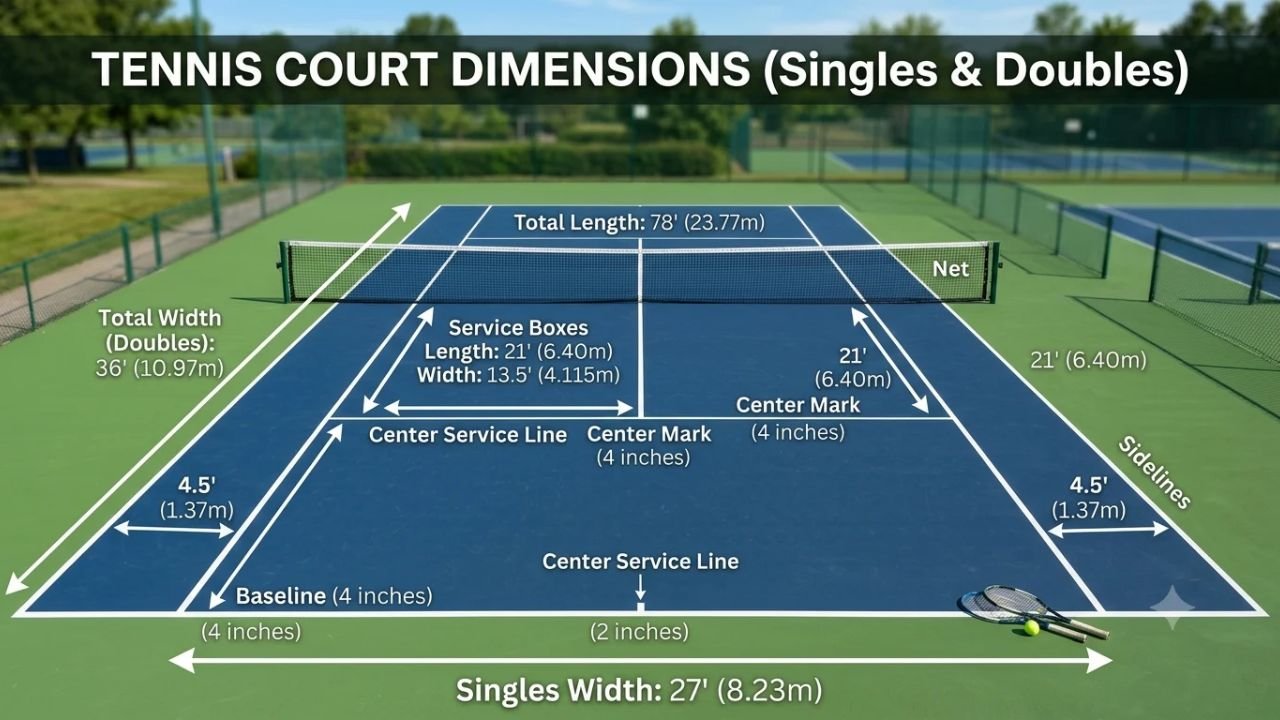
The standard tennis court is 78 feet long, which is approximately 23.77 meters. The width depends on whether the court is being used for singles or doubles.
For singles matches, the court is 27 feet wide, or about 8.23 meters.
For doubles matches, the court is 36 feet wide, or about 10.97 meters.
The length remains the same for both singles and doubles. The main difference is the additional width used in doubles matches.
This means the playing area of a standard tennis court can be understood as follows:
| Court Type | Length | Width |
|---|---|---|
| Singles | 78 ft (23.77 m) | 27 ft (8.23 m) |
| Doubles | 78 ft (23.77 m) | 36 ft (10.97 m) |
The extra width in a doubles court comes from the area between the singles sideline and the doubles sideline.
Tennis Court Dimensions in Meters
If you are planning a court outside the United States, measurements in meters may be easier to understand.
A standard tennis court is 23.77 meters long.
The singles playing width is 8.23 meters, while the doubles playing width is 10.97 meters.
These dimensions are used for standard tennis competition. The actual construction area can be larger because additional space is normally provided around the court.
Singles Tennis Court Dimensions
A singles tennis match is played between two players, one on each side of the net.
The singles court is 78 feet long and 27 feet wide. The singles sidelines mark the playing area used during a singles match.
The court is divided into two halves by the net. Each player serves from one side of the court and attempts to land the ball inside the correct service box on the opposite side.
Because singles play uses a narrower court than doubles, the outer doubles alleys are not part of the singles playing area.
Doubles Tennis Court Dimensions
Doubles tennis involves four players, with two players on each team.
The standard doubles court has the same length as the singles court, but it is wider. Its dimensions are 78 feet by 36 feet.
The additional width gives doubles players more space to cover the court.
The areas outside the singles sidelines and inside the doubles sidelines are commonly called the doubles alleys. These areas are used during doubles matches but are not part of the singles court.
Tennis Court Size in Feet
For quick reference, the standard dimensions are:
Length: 78 feet
Singles width: 27 feet
Doubles width: 36 feet
The total playing area of a doubles court is therefore larger than that of a singles court.
A doubles court covers approximately 2,808 square feet of playing area, while a singles court covers approximately 2,106 square feet.
These figures describe the marked playing area only. They do not include additional space around the court.
Tennis Court Size in Square Meters
The same measurements can also be converted into square meters.
A singles court measures approximately 195.6 square meters.
A doubles court measures approximately 260.9 square meters.
Again, these numbers represent the actual playing area. A complete tennis facility needs more land because players need clear space outside the court.
Tennis Court Net Height
The tennis net is one of the most important parts of the court.
At the center of the court, the net is approximately 3 feet high, or 0.914 meters.
At the net posts, the height is approximately 3 feet 6 inches, or 1.07 meters.
The net is positioned across the width of the court and divides it into two equal halves.
The difference between the height at the center and the height at the posts is created by the way the net is supported and pulled down at the center.
Tennis Court Service Boxes
The service boxes are the four smaller areas located near the net.
Each side of the court has two service boxes. During a serve, the ball must land in the diagonally opposite service box to be considered a legal serve.
The service line runs parallel to the net and separates the service boxes from the area behind them.
The center service line divides each side of the court into two service boxes.
Understanding these markings is important for beginners because the service boxes determine where a valid serve must land.
Tennis Court Lines and Their Purpose
Every line on a tennis court has a specific purpose.
The baseline is located at the back of each side of the court. Players serve from behind this line.
The singles sidelines mark the width of the singles court.
The doubles sidelines create the wider playing area used in doubles matches.
The service lines mark the front boundary of the service boxes.
The center service line divides the service area into two boxes.
The center mark is a small line located at the center of each baseline. It helps players identify their serving position.
These markings make it possible for officials and players to determine whether a ball lands inside or outside the legal playing area.
How Long Is a Tennis Court?
A standard tennis court is 78 feet long, regardless of whether the match is singles or doubles.
In metric measurements, this is approximately 23.77 meters.
The length does not change between singles and doubles. Only the width changes.
This standard length is used for competitive tennis and provides the same basic playing conditions across properly constructed courts.
How Wide Is a Tennis Court?
The width depends on the type of match.
A singles tennis court is 27 feet wide.
A doubles tennis court is 36 feet wide.
Therefore, a doubles court is 9 feet wider than a singles court.
The extra width comes from the doubles alleys located outside the singles sidelines.
How Much Space Is Needed to Build a Tennis Court?
The playing dimensions are not the same as the total space required for construction.
If you are planning to build a tennis court, you should provide additional room around the court. Players can move beyond the baseline and sidelines when chasing shots, so placing walls, fences, or other obstacles immediately next to the playing area would not be practical.
The required surrounding space can vary depending on the facility, level of play, safety requirements, fencing, lighting, seating, landscaping, and local regulations.
A recreational court may have different space requirements from a professional or tournament facility.
For this reason, anyone planning construction should consider the court plus surrounding run-off space, rather than using only the 78-foot by 36-foot playing dimensions.
Why Are Tennis Court Dimensions Important?
Correct dimensions are important because tennis depends heavily on consistent court markings.
If the court is too short, too wide, or incorrectly marked, players may experience a different game from the one intended by the rules.
Accurate measurements also ensure that:
The net is positioned correctly.
The service boxes have the correct proportions.
Singles and doubles boundaries are clearly defined.
Players have consistent distances to work with.
Officials can make accurate line calls.
Tournament courts can provide standardized playing conditions.
For professional tennis, these measurements are especially important because even small construction errors can affect play.
Tennis Court Orientation
The direction of a tennis court can also matter when planning a new facility.
Outdoor tennis courts are commonly positioned with consideration for the movement of the sun. Poor orientation can cause players to face strong sunlight directly during certain periods of the day.
Wind direction can also affect outdoor tennis.
Therefore, building a court is not simply about measuring 78 feet by 36 feet. Designers may also consider the local climate, sunlight, wind, drainage, fencing, lighting, and surrounding buildings.
Indoor vs Outdoor Tennis Court Dimensions
The basic playing dimensions remain standardized whether tennis is played indoors or outdoors.
An indoor court may have additional requirements because of the building structure. There must be enough vertical clearance above the playing area so that players can hit high shots without interference.
Outdoor courts usually have more flexibility around the playing area, but they still require sufficient clear space for safe movement.
The surface can also differ. Tennis courts may use hard court, clay, grass, carpet, or other approved surfaces, depending on the facility and competition.
Different Tennis Court Surfaces
Court dimensions remain important regardless of the surface.
A hard court generally has a firm, relatively consistent surface and is widely used at recreational and professional facilities.
A clay court has a softer surface and can influence how the ball bounces and how players move.
A grass court usually produces a faster style of play and has traditionally been associated with major tennis events.
The dimensions of the marked playing area remain standardized even though the characteristics of the surfaces can be very different.
Tennis Court Dimensions for Home Use
People building a tennis court at home may be tempted to reduce the dimensions because of limited space.
However, reducing the actual playing area changes the experience of the game.
If possible, a full-size court should be used for serious practice. If space is limited, smaller training courts can be useful for recreational activities, beginners, children, or specific practice drills.
Before construction, it is important to measure the entire available property rather than considering only the court itself.
You also need to consider fencing, gates, lighting, drainage, player movement, and access for maintenance.
FAQs
What are the standard tennis court dimensions?
A standard tennis court is 78 feet long. It is 27 feet wide for singles and 36 feet wide for doubles.
Are singles and doubles courts the same size?
They have the same length but different widths. Singles are 27 feet wide, while doubles are 36 feet wide.
How long is a tennis court in meters?
A standard tennis court is 23.77 meters long.
How wide is a doubles tennis court?
A standard doubles tennis court is 36 feet wide, which is approximately 10.97 meters.
How wide is a singles tennis court?
A singles tennis court is 27 feet wide, or approximately 8.23 meters.
What is the height of a tennis net?
The net is approximately 3 feet high at the center and about 3 feet 6 inches at the posts.
How big is a tennis court in square feet?
A singles playing area is approximately 2,106 square feet, while a doubles playing area is approximately 2,808 square feet.
Does the court size change for professional tennis?
The standard playing dimensions are used for competitive tennis. However, the total facility area can be larger because professional venues require additional space for player movement, officials, spectators, equipment, and other facilities.
Read Also: 65 Inch TV Dimensions
Final Thoughts
Understanding tennis court dimensions makes it easier to understand how the game is organized. The standard court is 78 feet long, while its width changes from 27 feet for singles to 36 feet for doubles.
The court also includes important measurements for the net, baselines, sidelines, service boxes, and other markings. These dimensions help create a consistent playing environment for tennis players around the world.
If you are simply learning about tennis, these measurements can help you understand the court better. If you are planning to build a court, remember that the marked playing area is only part of the overall space required. Additional room for player movement, fencing, lighting, drainage, and maintenance should also be considered.
1 thought on “Tennis Court Dimensions: Complete Guide to Court Size, Lines and Measurements”